
 EN
For brands importing paper packaging into the European Union, EUDR is no longer a distant policy issue. Large and medium operators are due to enter the main application phase on 30 December 2026, while most micro and small operators have until 30 June 2027.
The difficult question is not whether paper comes from wood. It clearly does. The difficult question is whether a particular packaging product is covered, who is considered the responsible operator, and what evidence must move through the supply chain.
The short answer is that many paper and paperboard packaging products can fall within EUDR scope, especially when empty packaging is imported into the EU as a product in its own right. However, scope should never be decided by the word "paper" alone. The product's Combined Nomenclature classification, material composition and route to market all matter.
This guide explains the practical points packaging buyers should review before placing an order.
What Is EUDR?
The EU Deforestation Regulation, formally Regulation (EU) 2023/1115, addresses products associated with seven relevant commodities: cattle, cocoa, coffee, oil palm, rubber, soya and wood.
Before an in-scope product is placed on the EU market or exported from it, the responsible operator must be able to demonstrate that the product:
-
is deforestation-free;
-
was produced in accordance with the relevant legislation of the country of production; and
-
is covered by the required due diligence statement or other applicable declaration under the Regulation.
For products made from wood, "deforestation-free" also includes a requirement that the wood was harvested without causing forest degradation after 31 December 2020.
EUDR is therefore not simply a request for an environmental certificate. It is a due diligence system based on product scope, traceability, evidence, risk assessment and regulatory declarations.
Are Paper and Paperboard Packaging Products Covered?
EUDR Annex I includes pulp and paper products in Chapters 47 and 48 of the EU Combined Nomenclature, subject to stated exclusions. Chapter 48 includes many paper and paperboard articles, while heading 4819 covers cartons, boxes, cases, bags and other packing containers of paper or paperboard.
That means an empty rigid box, folding carton, paper gift box or paperboard presentation pack imported into the EU may be an in-scope product when it is declared under a covered customs code.
However, a packaging supplier should not make a universal claim that every paper component is automatically covered in exactly the same way. The importer should confirm:
-
the product's CN or customs classification;
-
whether the packaging is imported empty or together with another product;
-
whether it is placed on the EU market as a product in its own right;
-
whether it is made entirely from recovered material that may meet a relevant exclusion; and
-
whether any special transitional or product-specific provisions apply.
If classification is unclear, the safest step is to confirm it with the importer's customs adviser or legal team before production begins. A packaging factory can supply product and material information, but it should not invent the buyer's customs classification.
Key EUDR Dates for Packaging Buyers
|
Business category |
Main application date |
|
Large and medium operators |
30 December 2026 |
|
Micro and small operators |
30 June 2027 |
|
Certain micro and small operators already covered by the EU Timber Regulation |
30 December 2026 |
The deadlines were amended after the original Regulation was adopted. Buyers should therefore use the current consolidated legislation and European Commission guidance rather than relying on older summaries.
Waiting until the application date to ask for fibre-origin information is risky. By then, the paper may already have been purchased, converted and mixed across production batches. Traceability is easier when the documentation requirement is included in the purchasing brief.
Who Is Responsible When Packaging Is Imported into the EU?
EUDR assigns obligations to operators, downstream operators and traders according to their role in placing or making relevant products available on the EU market.
For packaging manufactured outside the EU, the EU-based party that first places an in-scope product on the Union market will often have the central operator responsibility. The exact role depends on the commercial and customs arrangement.
The overseas packaging factory is still important, but its role is different. It may need to provide the product description, material composition, upstream supplier information, country-of-production data, batch references and other supporting evidence requested by the EU customer.
This distinction matters. A supplier can support an EUDR due diligence process, but the supplier should not claim to have completed the EU operator's legal obligations unless it has a defined role and the required information-system access.
What Information May Be Required?
The responsible operator's due diligence process can require information such as:
-
a clear description of the packaging product;
-
quantity and relevant product classification;
-
the common and scientific names of wood species where required;
-
country of production;
-
geolocation of the plots where the relevant wood was produced;
-
supplier and customer details;
-
evidence that the product is deforestation-free;
-
evidence that production complied with relevant local legislation;
-
risk-assessment records; and
-
risk-mitigation evidence where the assessed risk is not negligible.
For a converted paper box, some of this information originates far upstream, at forest, pulp and paper-mill level. The box factory cannot recreate missing forest-origin data after the event. It must work through its approved paper and board suppliers and keep the connection between incoming material and the finished order as clear as practical.
Is FSC Certification Enough for EUDR?
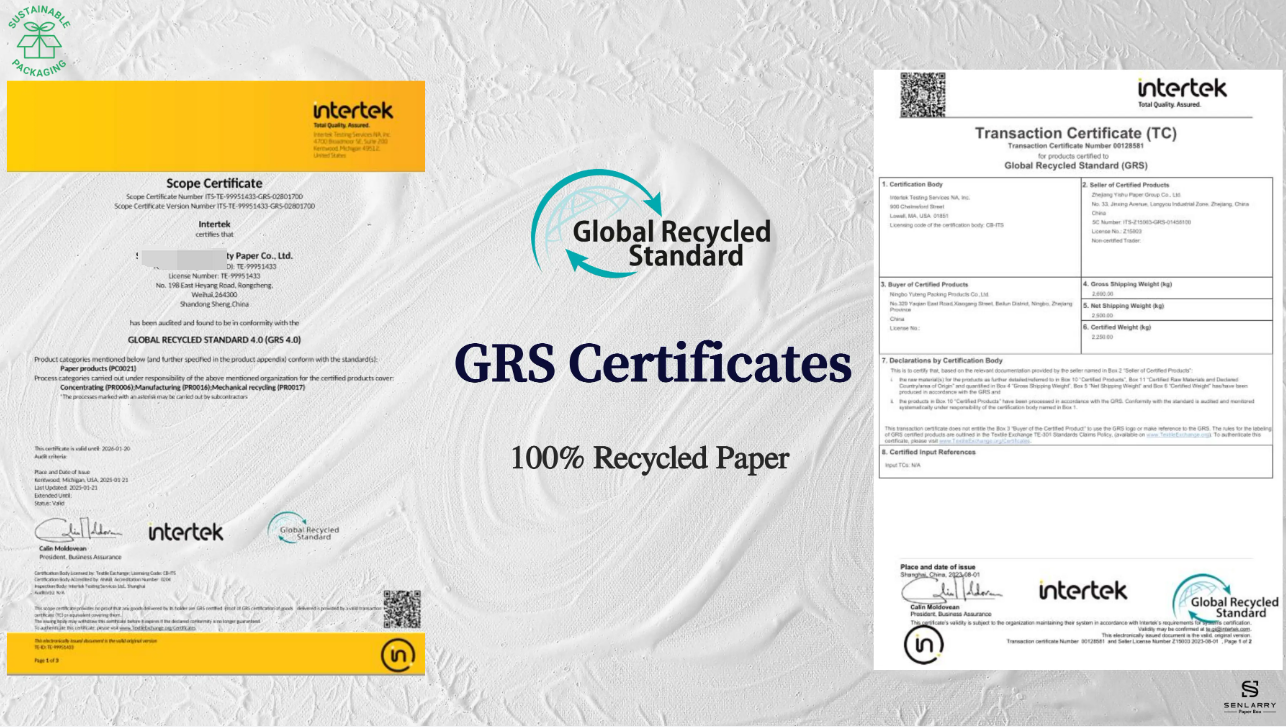
FSC chain-of-custody certification can be valuable supporting evidence. It can improve visibility over certified material flows and help buyers work with a more disciplined sourcing system.
It is not, by itself, a substitute for EUDR due diligence. EUDR asks the responsible operator to meet the Regulation's specific information, risk-assessment and declaration requirements. A certification document may support that process, but it does not automatically complete it.
For buyers, the better question is not "Does the supplier have FSC?" It is:
Can the supplier connect the material used for this order to credible upstream information and provide the records needed for our due diligence process?
How Senlarry Supports EUDR-Aligned Packaging Projects
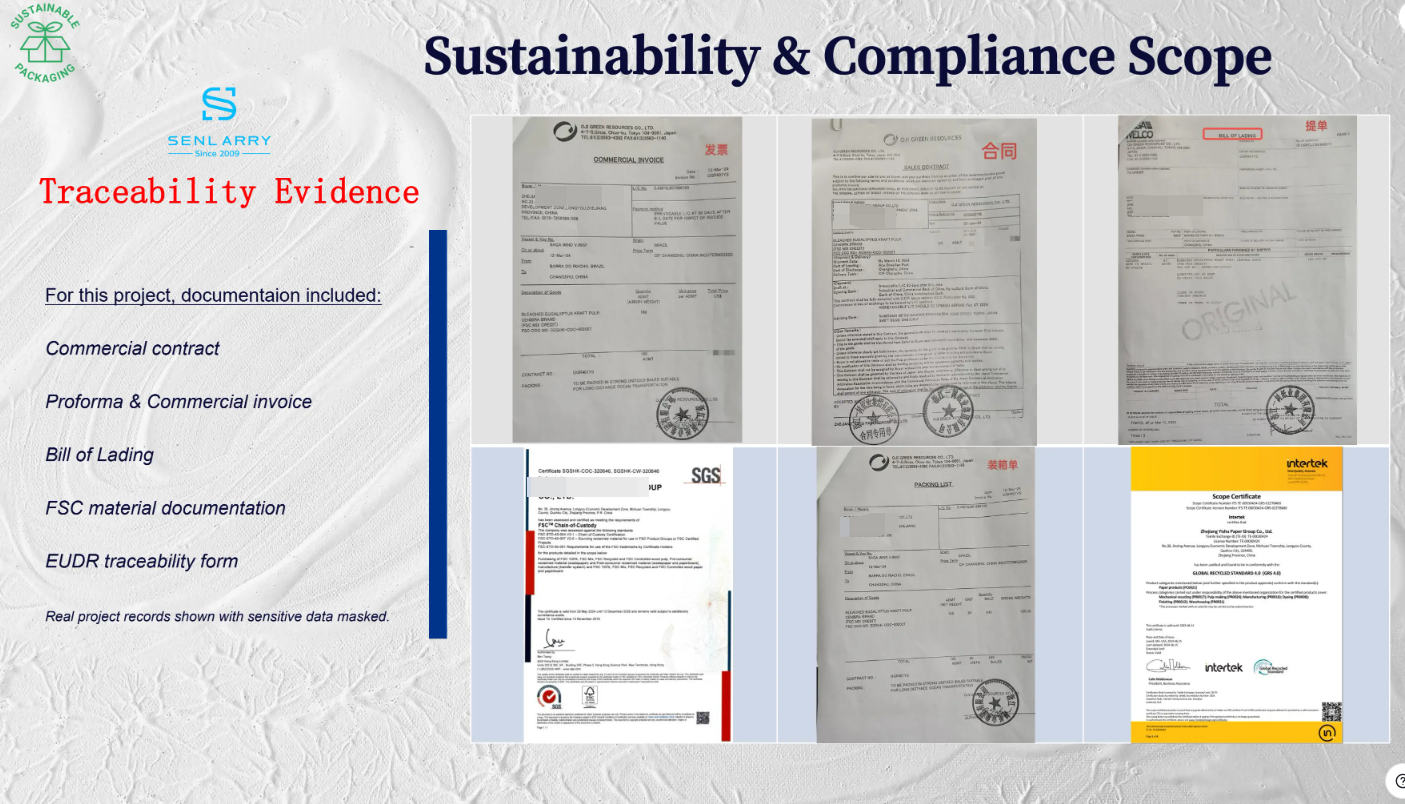
At Senlarry Packaging, we treat traceability as a project requirement rather than a logo added at the end. Depending on the product and customer brief, our support can include:
Market and scope briefing
We ask where the packaging will be placed on the market, what form it will be imported in and whether the customer has specified an EUDR documentation requirement.
Material mapping
We create a bill of materials covering the main paper-based components, including outer paper, greyboard, folding box board, corrugated board and paper inserts where applicable.
FSC material options
For projects requiring FSC-certified material, we can source suitable paper options and manage the order through the relevant controlled purchasing and production process.
Supplier and batch records
We retain purchasing and production references that help connect approved materials to the relevant packaging order. If a material changes after sampling, the change should be recorded and communicated rather than silently substituted.
Upstream-document coordination
Where EUDR-related information is required, we coordinate with paper and board suppliers to collect available upstream documentation for the customer's review.
Production control
Traceability loses value if the approved material is not the material used in production. Our production and QC process therefore needs to maintain alignment between the approved specification, incoming material and finished packaging.
This is best described as EUDR-aligned sourcing and documentation support. There is no need to dress it up as "EUDR-certified packaging," which is not an accurate description of the Regulation.
What Buyers Should Do Before Ordering
Before sending a packaging project to production, an EU buyer should:
-
Confirm whether the packaging product is in scope.
-
Validate the relevant customs classification.
-
Identify which legal entity will act as the operator.
-
Add EUDR information requirements to the supplier brief.
-
Confirm whether virgin, certified, recycled or mixed fibre is being used.
-
Review gaps in upstream data before approving materials.
-
Define how batch and order records will be retained.
-
Confirm who will prepare and submit the required declaration.
The earlier these questions are asked, the easier the project becomes. Asking for full traceability after mass production is complete is the packaging equivalent of asking for a map after the shipment has already left.
Frequently Asked Questions
Does EUDR apply to rigid paper boxes?
It may. Rigid paper boxes can fall within covered Chapter 48 classifications when imported as packaging products. The importer should confirm the exact CN code and commercial scenario.
Does EUDR apply to recycled paper packaging?
The Regulation contains exclusions for certain goods produced entirely from material that has completed its lifecycle and would otherwise have been discarded as waste. This should not be interpreted as an automatic exemption for every product marketed as recycled. Material composition and product classification still need to be verified.
Does FSC certification prove EUDR compliance?
No. FSC certification can support traceability and responsible sourcing, but the EUDR operator must still meet the applicable due diligence requirements.
Can a Chinese packaging supplier submit the EUDR due diligence statement?
The legal responsibility usually sits with the relevant operator placing the product on the EU market. A non-EU packaging supplier can provide supporting supply-chain information, but responsibilities should be confirmed for the specific transaction.
When should EUDR requirements be discussed with the supplier?
Before material approval and ideally before quotation. Upstream traceability requirements can affect material selection, supplier choice, documentation lead time and cost.
Plan Compliance Before Production
EUDR is changing the way paper packaging projects are briefed and documented. The strongest response is not a new marketing claim. It is a more disciplined connection between material selection, supplier records, production batches and the information required by the EU operator.
If you are preparing a paper packaging project for the EU market, share the product type, target country, expected quantity and documentation requirements with our team. We can review the packaging structure and explain what sourcing and production records we can support before sampling begins.
Official References
-
European Commission, Regulation on Deforestation-free Products: https://environment.ec.europa.eu/topics/forests/deforestation/regulation-deforestation-free-products_en
-
EUR-Lex, consolidated Regulation (EU) 2023/1115: https://eur-lex.europa.eu/legal-content/EN/TXT/?uri=CELEX:02023R1115-20251226
This article provides general packaging information and is not legal advice. Buyers should confirm product classification and legal obligations with qualified advisers.