
 EN
EUDR due diligence does not begin when a shipment reaches European customs. For paper packaging, it begins much earlier, when the buyer defines the product, the converter selects the paper and board, and upstream suppliers connect those materials to origin data.
This timing matters because a finished box can contain several fibre-based components: printed paper, greyboard, folding box board, corrugated board, tissue, paper inserts and labels. Each component may come from a different supplier or mill. If the project waits until mass production is complete to ask for supporting data, the traceability chain may already be difficult to reconstruct.
The following checklist is designed for EU brands and importers buying custom paper packaging. It shows what information should be discussed, where it is likely to originate, and how a packaging supplier can support the process.
Start with the Product, Not the Certificate
The first EUDR question should not be "Do you have FSC?" It should be "What exactly are we importing?"
Before requesting documents, identify:
-
the packaging format;
-
whether it is imported empty or with a product;
-
its intended customs classification;
-
the quantity and unit of measure;
-
the fibre-based components in the construction;
-
whether each component uses virgin, recycled or mixed fibre; and
-
the legal entity expected to place the product on the EU market.
A general factory certificate cannot answer a product-specific due diligence question. EUDR works at product and supply-chain level, so the documentation must connect to the actual goods being placed on the market.
The Core Documentation Checklist
|
Information or document |
Why it matters |
Main source |
|
Product description and SKU |
Identifies the exact packaging covered by the review |
Buyer and packaging supplier |
|
CN or customs classification |
Determines whether the product is within Annex I scope |
EU importer or customs adviser |
|
Quantity and unit of measure |
Required for product and shipment records |
Buyer and supplier |
|
Bill of materials |
Shows paper, board, insert and label components |
Packaging supplier |
|
Common and scientific wood species, where required |
Supports product information requirements |
Mill and upstream supplier |
|
Country of production |
Identifies where the relevant commodity was produced |
Upstream supply chain |
|
Plot geolocation data |
Supports deforestation and forest-degradation assessment |
Forest, mill or upstream data provider |
|
Supplier identity and contact details |
Establishes the commercial chain |
Each supply-chain party |
|
Evidence of legal production |
Supports legality assessment |
Upstream producer and supplier |
|
FSC or other certification records |
May provide supporting traceability evidence |
Certified supply-chain parties |
|
Purchase order and batch references |
Connects incoming material to the finished order |
Packaging supplier |
|
Risk-assessment and mitigation records |
Demonstrates the operator's due diligence |
EU operator |
|
Due diligence statement reference |
Connects the relevant product to the EU filing |
EU operator or applicable upstream party |
Not every field will be owned by the packaging factory. A useful documentation process makes ownership visible instead of allowing everyone to assume that another party has handled it.
Step 1: Confirm Product Classification
EUDR applies only to relevant products listed in Annex I. Pulp and paper products in Chapters 47 and 48 are included, subject to the Regulation's wording and exclusions.
For custom boxes, heading 4819 is often relevant, but the final classification belongs in the importer's customs review. The supplier should provide enough information for that decision, including:
-
box type and construction;
-
principal material;
-
whether the product is a carton, box, case, bag or other container;
-
whether non-paper components materially change the product; and
-
how the packaging is shipped and invoiced.
Do not use a previous shipment's HS code automatically if the structure or material has changed.
Step 2: Build a Packaging Bill of Materials
The bill of materials should go beyond "paper box." A rigid gift box may include:
-
specialty wrapping paper;
-
greyboard;
-
coated printed paper;
-
paperboard or corrugated insert;
-
tissue or paper accessories;
-
labels;
-
magnets;
-
ribbon, elastic or textile components;
-
EVA, foam, acrylic or plastic parts; and
-
adhesives, ink, foil or lamination.
EUDR traceability focuses on the relevant commodities and products, while other materials may create separate PPWR or chemical-compliance questions. A clear bill of materials helps the buyer route each issue correctly.
The approved material specification should also state whether substitutions are allowed. Changing from one board supplier to another during production can break the evidence chain if the change is not recorded.
Step 3: Identify the Country of Production and Plot Data
For EUDR, "country of production" refers to where the relevant commodity was produced, not simply where the finished box was converted.
A statement that a box was "Made in China" therefore does not establish where the wood fibre originated. The conversion factory may need to obtain information through the paper merchant, board supplier, pulp producer or mill.
Geolocation data relates to the plots of land where the relevant commodity was produced. For long paper supply chains, this can be the most demanding part of the information request. Buyers should ask early whether the selected paper supply chain can support the required upstream data.
If the data is unavailable, the correct response is to identify the gap and reconsider the material or supplier. A vague letter stating that a material is "eco-friendly" is not a substitute for traceability.
Step 4: Connect Incoming Material to the Finished Order
Upstream documents are only useful when they can be connected to the packaging being purchased.
The packaging supplier should maintain practical links between:
-
customer project or SKU;
-
approved sample and material specification;
-
supplier purchase order;
-
incoming material batch or delivery record;
-
production work order;
-
quality-control record; and
-
finished shipment.
The system does not need to be theatrical. A clear, auditable trail is more useful than a thick folder of unrelated certificates.
At Senlarry Packaging, this means treating material changes as controlled changes. If the approved paper, board or supplier must change, the project team should confirm the new specification and documentation impact before using it.
Step 5: Review Certification in the Right Context
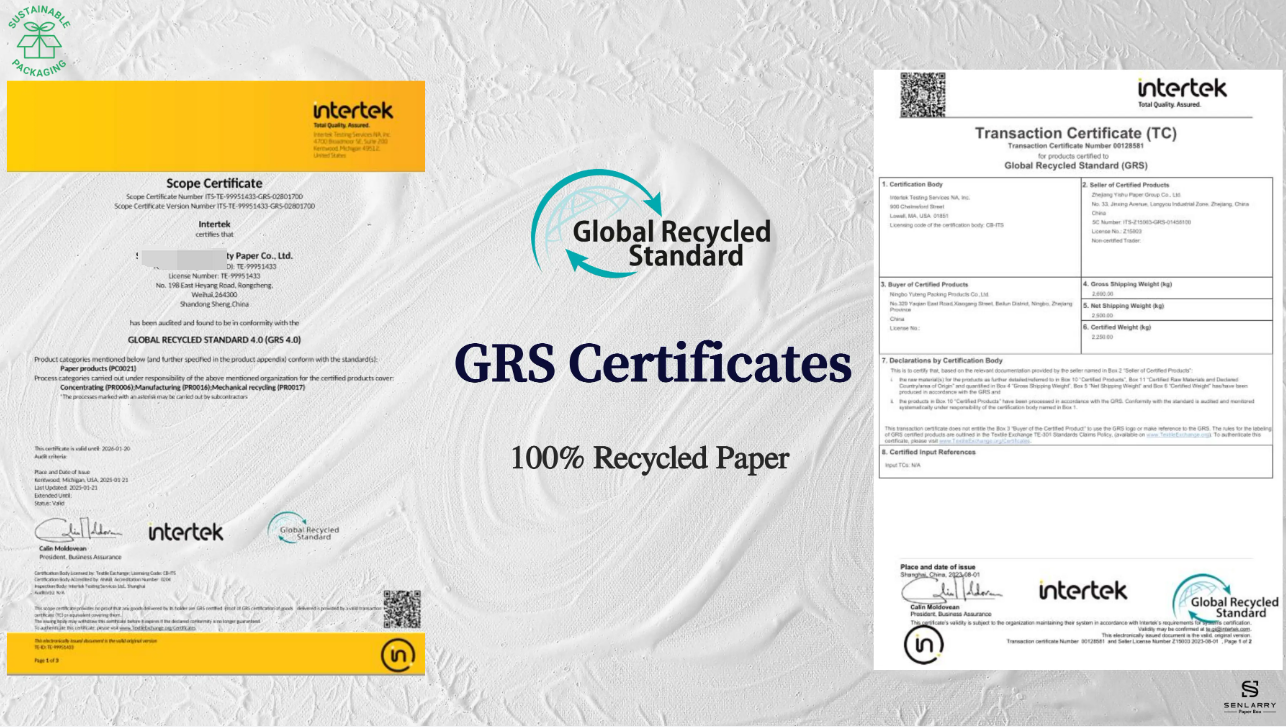
FSC chain-of-custody certification can support a structured material-control process and help verify how certified claims move through the supply chain.
However, certification and EUDR due diligence are not the same task. The EU operator still needs to review whether the information required by EUDR is complete, assess risk and submit the applicable declaration.
Buyers should therefore check:
-
whether the certificate is valid;
-
which legal entity and site it covers;
-
whether the relevant product is within scope;
-
which FSC claim is being offered;
-
whether the invoice and product documentation carry the required claim; and
-
what additional EUDR data is available beyond the certificate.
This approach avoids both extremes: dismissing certification as irrelevant or treating it as an automatic legal shortcut.
Step 6: Assess Risk and Resolve Gaps
Collecting documents is not the end of due diligence. The responsible operator must assess the risk that the product does not meet the Regulation's deforestation-free and legality requirements.
The review may consider:
-
country risk classification;
-
complexity of the supply chain;
-
document consistency;
-
risk of mixing with material of unknown origin;
-
reliability of suppliers;
-
evidence of legal harvesting and production;
-
corruption, conflict or enforcement concerns; and
-
whether independent verification or additional information is needed.
Where the risk is not negligible, mitigation may require more evidence, a supplier audit, independent checks or a different material source. The packaging supplier can respond to information requests, but the EU operator owns the final assessment for its transaction.
Step 7: Manage Due Diligence Statement References
The EUDR Information System is used for regulatory declarations. The party responsible for submitting a due diligence statement should be identified before shipment.
Project teams should define:
-
who will submit the declaration;
-
what shipment, product and quantity it covers;
-
which reference numbers must be communicated downstream;
-
how changes in quantity or material will be handled; and
-
how records will be retained.
Do not paste one reference number across unrelated orders without checking what it covers. Traceability works only when references remain connected to the correct products and transactions.
What Senlarry Can Support
For an EUDR-aligned paper packaging project, Senlarry can support the customer with information generated or controlled at packaging-conversion level, including:
-
finished packaging description and specification;
-
material bill of materials;
-
approved paper and board information;
-
supplier and purchasing references;
-
available FSC documentation for applicable orders;
-
production work-order and batch linkage;
-
records of approved material changes;
-
finished quantity and shipment information; and
-
coordination with upstream paper suppliers for available origin documents.
What the EU Buyer or Importer Still Needs to Own
The customer or relevant EU operator should retain responsibility for:
-
confirming EUDR scope and customs classification;
-
determining its legal role;
-
evaluating the completeness and reliability of upstream information;
-
conducting the required risk assessment;
-
carrying out risk mitigation where necessary;
-
preparing and submitting the applicable declaration; and
-
responding to competent authorities.
Putting this division into the purchase specification prevents confusion later.
Common Documentation Red Flags
Packaging buyers should pause when they see:
-
"EUDR certified" with no explanation of what was assessed;
-
a factory certificate with no connection to the ordered material;
-
country-of-manufacture information presented as fibre-origin data;
-
an FSC logo without a valid claim or chain-of-custody context;
-
product descriptions too vague to match the shipment;
-
unexplained material substitutions after sample approval;
-
documents carrying inconsistent supplier names or quantities; or
-
a promise that all evidence will be created after production.
Compliance should make the supply chain clearer. If the paperwork creates more ambiguity, it is not doing its job.
Frequently Asked Questions
Should EUDR documents be requested at quotation stage?
Yes. Early discussion allows the supplier to select materials and upstream sources capable of supporting the required information. It also makes documentation cost and lead time visible.
Who confirms the CN code for a paper box?
The EU importer should confirm the final classification, usually with customs or legal support. The packaging supplier provides accurate product and material details.
Can one document pack cover multiple SKUs?
Possibly, if the SKUs genuinely share the same materials, upstream sources and traceability records. Differences in material, supplier or production batch should remain visible.
Is a supplier declaration enough?
It may be one piece of evidence, but the responsible operator must evaluate the complete information set and the risk associated with the supply chain.
How long should EUDR records be kept?
Operators must keep their due diligence statements and supporting documentation for at least five years. The retention process should also preserve the connection between the imported product, its production batch and the upstream evidence used in the risk assessment.
Build the Evidence Chain Before the Box
EUDR documentation is easiest to manage when it is treated as part of material sourcing and production planning. The box specification, supplier choice, batch records and upstream data should support the same story.
If your EU packaging project has an EUDR information checklist, send it with the structural brief. Senlarry can review which fields we can support, identify missing upstream information and align the documentation process before materials are approved.
Official References
-
European Commission, Regulation on Deforestation-free Products: https://environment.ec.europa.eu/topics/forests/deforestation/regulation-deforestation-free-products_en EUR-Lex, consolidated Regulation (EU) 2023/1115: https://eur-lex.europa.eu/legal-content/EN/TXT/?uri=CELEX:02023R1115-20251226
This article provides general packaging information and is not legal advice. Buyers should confirm product classification and legal obligations with qualified advisers.
Table of Contents
- Start with the Product, Not the Certificate
- The Core Documentation Checklist
- Step 1: Confirm Product Classification
- Step 2: Build a Packaging Bill of Materials
- Step 3: Identify the Country of Production and Plot Data
- Step 4: Connect Incoming Material to the Finished Order
- Step 5: Review Certification in the Right Context
- Step 6: Assess Risk and Resolve Gaps
- Step 7: Manage Due Diligence Statement References
- What Senlarry Can Support
- What the EU Buyer or Importer Still Needs to Own
- Common Documentation Red Flags
- Frequently Asked Questions