
 EN
The EU Packaging and Packaging Waste Regulation is changing packaging development from a largely visual and commercial exercise into a more documented engineering process.
For brands using custom rigid boxes, folding cartons, gift sets, PR kits and paper-based presentation packaging, the question is no longer only whether the box looks premium. Teams also need to understand how the packaging is constructed, whether its components can be separated, how much material is necessary, what information must be retained and which legal entity is responsible for placing it on the EU market.
Regulation (EU) 2025/40, commonly known as the PPWR, has applied generally since 12 August 2026. However, its requirements do not all begin on the same day. Several measures depend on future dates, delegated acts, implementing acts or transitional rules.
This guide focuses on the practical design and documentation questions that brands and importers should discuss with a custom paper packaging supplier now.
What Does PPWR Cover?
PPWR applies broadly to packaging placed on the EU market, whether the packaging is empty or filled, made inside or outside the EU, and regardless of its material.
The Regulation covers the packaging lifecycle, including:
-
substances in packaging;
-
recyclability;
-
recycled content in plastic packaging;
-
compostable packaging;
-
packaging minimisation;
-
labelling and consumer information;
-
reuse and refill systems;
-
extended producer responsibility; and
-
conformity assessment and technical documentation.
For an overseas packaging supplier, PPWR matters because EU brands and importers increasingly need product data and evidence from upstream manufacturers. For the EU customer, it matters because only conforming packaging may be placed on the market.
Understand the Timeline Before Making Claims
|
Date |
Key milestone relevant to packaging projects |
|
11 February 2025 |
PPWR entered into force |
|
12 August 2026 |
PPWR became generally applicable, subject to transitional and phased provisions |
|
12 August 2028 or later where specified |
Harmonised material-composition labelling begins under the Regulation's timing conditions |
|
1 January 2030 |
Packaging minimisation requirements apply; design-for-recycling performance grading begins |
|
2035 |
Recyclability assessment expands to include recycling at scale under the Regulation's framework |
This phased timetable is important. A supplier should not tell customers that every 2030 requirement is already mandatory in 2026. Equally, brands should not wait until 2030 to change designs that take 12 to 24 months to develop and scale.
The practical approach is to identify which requirements apply now, which design decisions could create future risk, and which technical details need to be documented from the beginning.
Design for Recycling Starts with Material Architecture
Paper packaging is often described as recyclable, but a paper-looking box is not necessarily a simple paper product.
A luxury box may include:
-
greyboard wrapped with specialty paper;
-
plastic film lamination;
-
aluminium-based foil decoration;
-
magnets;
-
acrylic windows or decorative plaques;
-
EVA or PU foam inserts;
-
flocking;
-
textile ribbons or elastic;
-
metal accessories; and
-
multiple adhesives.
PPWR does not automatically ban a premium box because it uses more than one material. The design question is whether the packaging meets the applicable recyclability criteria and whether components that interfere with recycling can be avoided, reduced or separated.
At concept stage, the packaging team should ask:
-
Can a mixed-material component be removed without reducing product protection?
-
Can it be replaced with a fibre-based alternative?
-
Can it be easily separated by the user or during sorting?
-
Does a finish materially affect the main paper recycling stream?
-
Is the component decorative, functional or both?
-
Can the same brand effect be achieved through structure, texture or print instead?
These questions are more useful than simply asking for an "eco-friendly box."
Packaging Minimisation Is Not the Same as Cheapening the Pack
From 1 January 2030, manufacturers or importers must ensure that packaging weight and volume are reduced to the minimum necessary for functionality, taking account of the packaging's shape and material.
The Regulation specifically challenges features used only to increase perceived product volume, including unnecessary layers, false bottoms and double walls. It also recognises legitimate performance needs such as product protection, logistics, hygiene, information requirements, gifting and recyclability.
For premium packaging, minimisation therefore does not mean reducing every board thickness or removing every presentation feature. It means being able to explain why the structure and material are necessary.
A practical minimisation review can examine:
-
product-to-box dimensions;
-
empty space around the product;
-
board thickness compared with product weight;
-
number of structural layers;
-
insert volume;
-
decorative components;
-
shipping-carton utilisation;
-
pallet efficiency; and
-
the risk of product damage if material is reduced.
The final design should balance brand presentation, product protection and material efficiency. A damaged perfume bottle is not a sustainable outcome merely because its box used less board.
Inserts Deserve Their Own Compliance Review
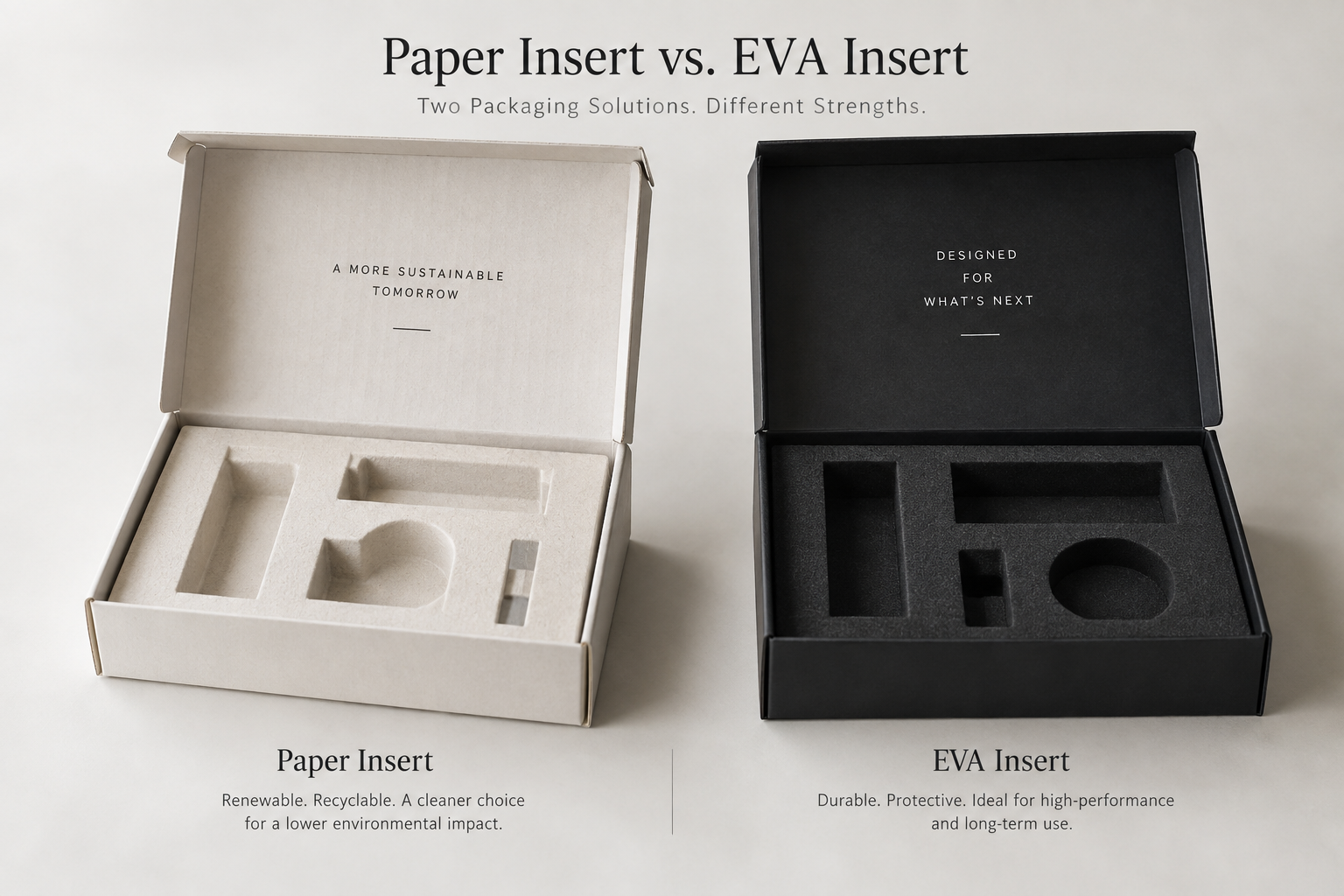
The insert is often the most material-complex part of a premium package.
Paperboard inserts
Folded paperboard inserts can support mono-material design and efficient flat production. They work well when the product is relatively light and the geometry allows structural locking.
Molded pulp inserts
Molded pulp can provide cushioning and a fibre-based appearance. Tooling, surface finish, tolerance and product contact requirements need to be considered.
EVA and foam inserts
EVA and other foams offer precise fit, strong presentation and good protection, especially for glass bottles, electronics, jewellery and instruments. They also introduce a non-paper component that may complicate material separation and recycling.
The correct solution depends on product weight, fragility, presentation expectations, distribution conditions, order volume and target-market requirements. A PPWR-oriented review should document why the selected insert is necessary and whether a lower-complexity alternative was evaluated.
Finishes Need Technical, Not Moral, Evaluation
Luxury packaging discussions often reduce finishes to a binary choice: sustainable or unsustainable. Real production is more nuanced.
Hot foil, embossing, debossing, UV, specialty coatings and lamination perform different functions and use different material amounts. Their impact depends on coverage, substrate, application method and the recycling process used in the destination market.
Brands should ask suppliers for specific information:
-
finish type and coverage;
-
film or coating specification;
-
whether the finish can be reduced to selected areas;
-
whether an unlaminated or alternative-coated paper can meet performance needs;
-
whether decorative components can be removed or separated; and
-
whether test data or supplier declarations are available.
"No finish" is not automatically the best design. A restrained, technically understood finish is usually more defensible than a vague sustainability claim.
Labelling Requirements Are Being Harmonised
PPWR introduces harmonised labelling intended to help consumers identify material composition and sort packaging correctly. The Regulation provides for future labels based on pictograms and, in some cases, digital data carriers.
The main harmonised material-composition label is scheduled to apply from 12 August 2028 or 24 months after the relevant implementing acts enter into force, whichever is later under the applicable provision.
Brands developing packaging now should leave enough artwork and structural flexibility for future marking requirements. Printing a speculative recycling symbol before the official format and applicability are confirmed can create rework rather than compliance.
Technical Documentation Becomes Part of the Packaging Product
PPWR requires manufacturers to carry out the applicable conformity assessment and establish technical documentation. Depending on the requirement and packaging type, the technical file can include:
-
a general description of the packaging and intended use;
-
conceptual design and manufacturing drawings;
-
materials used in components;
-
explanations needed to understand the design;
-
applicable harmonised standards or technical specifications;
-
assessment of relevant requirements;
-
test reports; and
-
evidence that serial production remains consistent with the approved specification.
The Regulation also provides for an EU declaration of conformity. Importers must ensure that the applicable assessment and documentation requirements have been addressed before placing packaging on the market.
This changes the supplier conversation. A buyer may need more than a quotation, artwork PDF and pre-production sample. The project may also require a controlled material list, drawings, specification records, supplier declarations and test evidence.
A Practical PPWR-Oriented Development Process
At Senlarry Packaging, a compliance-aware project can be organised through the following steps.
1. Confirm the market and responsible parties
Identify where the packaging will be sold, whether it is imported empty or filled, and which party will act as manufacturer or importer for PPWR purposes.
2. Create the structural and material specification
Record the board, wrapping paper, print, finish, insert, accessories, adhesives and other components rather than describing the product only as a "rigid box."
3. Review material complexity
Assess magnets, windows, acrylic, EVA, foam, ribbon, lamination and other non-paper elements. Determine whether each element is functional, decorative, removable or replaceable.
4. Review weight, volume and empty space
Optimise the fit around the product without compromising protection, assembly or the intended gifting experience.
5. Prototype and test
Check product fit, closure, insert retention, handling, abrasion, transit performance and production feasibility. A compliant idea still needs to survive real distribution.
6. Prepare supplier-side records
Maintain the approved bill of materials, drawings, material data, sample approvals, change records and QC evidence that the customer may require for its technical file.
7. Control mass production
Ensure that series production follows the approved specification. A last-minute material substitution can affect both appearance and documentation.
Senlarry has supported a PPWR-oriented project for a UK-based brand solutions company. The main lesson was practical: compliance is easier when the destination market, material composition and documentation expectations are defined before sampling, not after the design has been approved.
What Senlarry Can and Cannot Claim
Senlarry can support:
-
material and structure review;
-
right-sizing and material-reduction proposals;
-
paperboard and molded-pulp insert options;
-
separation-focused design discussions;
-
bill-of-materials preparation;
-
manufacturing drawings and specifications;
-
sampling and production controls;
-
relevant supplier information; and
-
documentation requested by the customer for its technical file.
Senlarry should not describe a package as "PPWR certified." PPWR is a legal framework, not a single general packaging certificate issued by the factory.
The more accurate language is:
-
PPWR-oriented packaging development;
-
PPWR-aligned design and documentation support; or
-
packaging developed to support the customer's PPWR compliance process.

Frequently Asked Questions
Does PPWR apply to packaging manufactured outside the EU?
Yes. PPWR covers packaging placed on the EU market regardless of where it was manufactured.
Are paper boxes automatically PPWR compliant?
No. Paper-based construction can support recyclability, but the full structure, components, substances, labelling and documentation still need to be reviewed.
Does PPWR ban luxury rigid boxes?
No. Premium and gift packaging are not automatically prohibited. The packaging must meet the requirements applicable to its category and timeline, including future recyclability and minimisation rules.
Does FSC certification prove PPWR compliance?
No. FSC addresses responsible forest-based sourcing and chain of custody. PPWR covers a different set of packaging-design, waste, information and conformity requirements.
Do magnets, EVA or acrylic make a box illegal?
Not automatically. They can increase material complexity and may affect recyclability or separation. Their function and alternatives should be evaluated and documented.
Build Compliance into the Brief
PPWR makes one point very clear: packaging compliance cannot be added as a sticker after production. It depends on decisions made during structural design, material selection, testing, documentation and manufacturing control.
If you are developing custom packaging for the EU market, send us the product dimensions, weight, target country, order quantity and compliance brief. We can review the structure and identify practical options to reduce unnecessary material, improve component separation and prepare clearer supplier-side documentation before sampling starts.
Official References
-
European Commission, Packaging Waste and PPWR overview: https://environment.ec.europa.eu/topics/waste-and-recycling/packaging-waste_en
-
EUR-Lex, Regulation (EU) 2025/40: https://eur-lex.europa.eu/legal-content/EN/TXT/?uri=OJ:L_202500040
-
European Commission, PPWR Frequently Asked Questions: https://environment.ec.europa.eu/publications/faq-packaging-and-packaging-waste-regulation-ppwr_en
This article provides general packaging information and is not legal advice. Requirements and implementation details should be confirmed for the relevant packaging category, market and date.
Table of Contents
- What Does PPWR Cover?
- Understand the Timeline Before Making Claims
- Design for Recycling Starts with Material Architecture
- Packaging Minimisation Is Not the Same as Cheapening the Pack
- Inserts Deserve Their Own Compliance Review
- Finishes Need Technical, Not Moral, Evaluation
- What Senlarry Can and Cannot Claim
- Frequently Asked Questions