
 EN
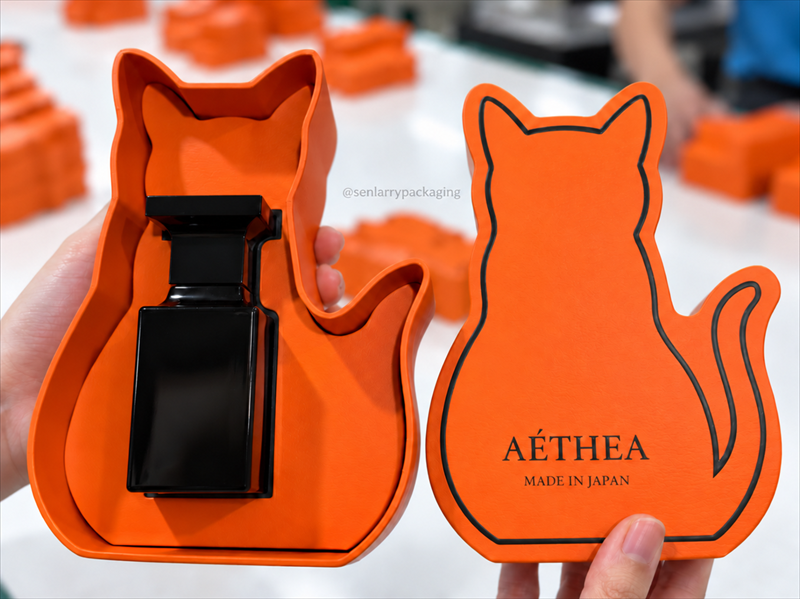
The outer box gets most of the attention in a packaging presentation. The insert does most of the quiet work.
It holds the product in position, protects it during transport, controls the reveal and influences how premium the packaging feels when opened. It can also become the most material-intensive and technically demanding part of the pack.
There is no single best insert for every project. Paperboard, molded pulp, EVA and other foams solve different problems. The right choice depends on product weight, fragility, shape, presentation, order volume, assembly process, distribution conditions and target-market requirements.
This guide compares the main options used in custom rigid boxes, folding cartons, gift sets and PR kits.
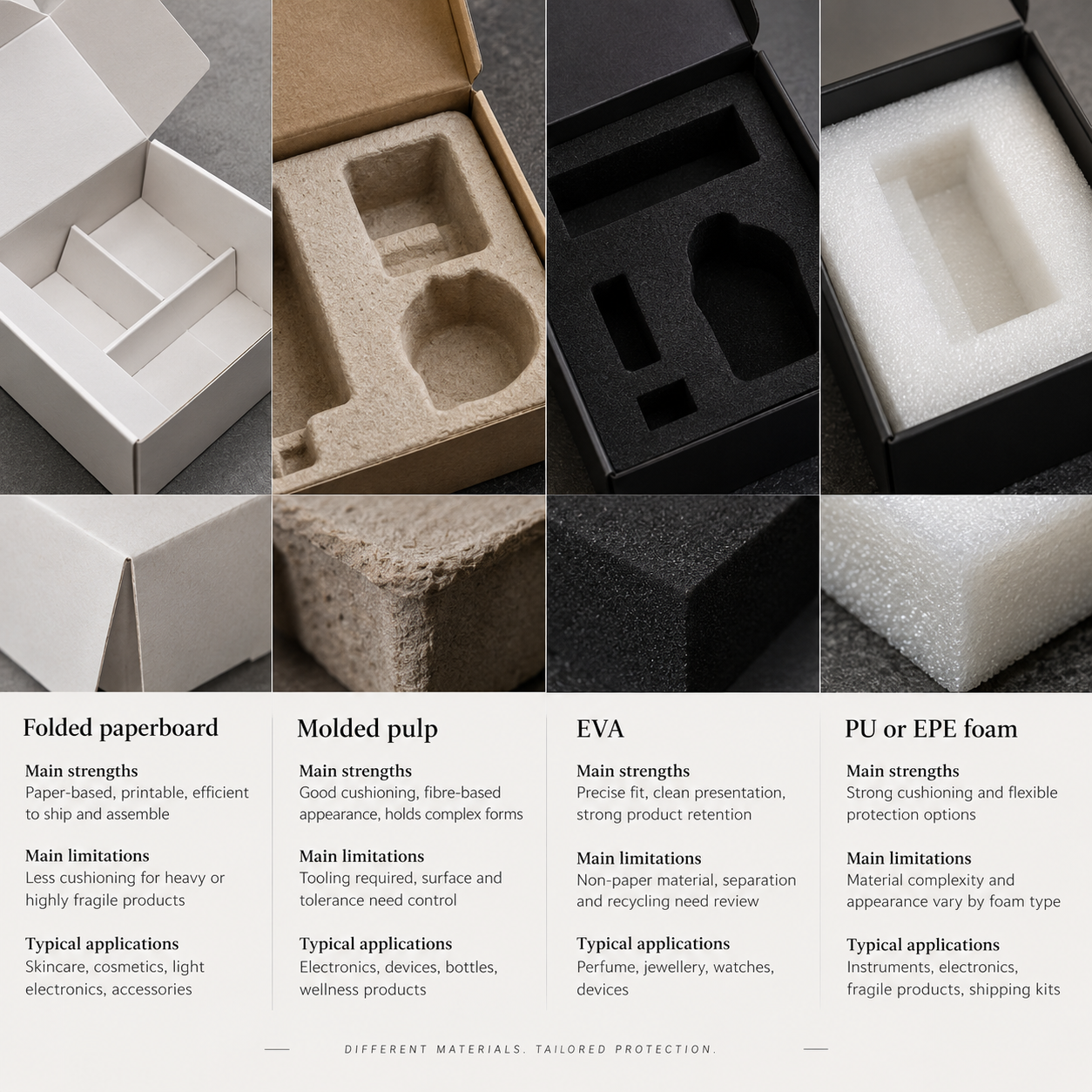
Quick Comparison
|
Insert type |
Main strengths |
Main limitations |
Typical applications |
|
Folded paperboard |
Paper-based, printable, efficient to ship and assemble |
Less cushioning for heavy or highly fragile products |
Skincare, cosmetics, light electronics, accessories |
|
Molded pulp |
Good cushioning, fibre-based appearance, holds complex forms |
Tooling required, surface and tolerance need control |
Electronics, devices, bottles, wellness products |
|
EVA |
Precise fit, clean presentation, strong product retention |
Non-paper material, separation and recycling need review |
Perfume, jewellery, watches, devices |
|
PU or EPE foam |
Strong cushioning and flexible protection options |
Material complexity and appearance vary by foam type |
Instruments, electronics, fragile products, shipping kits |
Paperboard Inserts
Paperboard inserts are die-cut and folded to create platforms, cavities, locks and product supports. They can be produced from folding box board, kraft board, corrugated board or other paper-based substrates depending on the product.
Advantages
-
Supports a paper-based packaging direction.
-
Can be printed to match the box artwork.
-
Ships flat or semi-flat in many designs.
-
Uses die-cutting and folding processes familiar to paper packaging production.
-
Can be designed with tabs and locks rather than permanent adhesive.
-
Usually gives a clean, structured presentation.
Limitations
-
May not provide enough cushioning for heavy glass or sensitive electronics.
-
Complex product shapes can require several folds or components.
-
Poorly designed locks may release during transport.
-
White cut edges or exposed fluting may affect the intended appearance.
-
Strength can change with paper grade, grain direction and humidity.
Best suited to
Paperboard inserts work particularly well for skincare jars, cosmetic sets, candles, lightweight devices, phone accessories and products with regular geometry.
They are also useful for multi-SKU programmes because the outer box can sometimes remain consistent while the insert changes for different products.
Molded Pulp Inserts
Molded pulp inserts are formed from fibre slurry using tooling. They can create shaped cavities, ribs and support zones around the product.
Advantages
-
Provides cushioning and structural support.
-
Offers a fibre-based material direction.
-
Can hold irregular shapes more naturally than folded board.
-
Creates a distinctive tactile appearance.
-
Can reduce the need for plastic trays or foam in suitable projects.
Limitations
-
Requires tooling and development time.
-
Surface smoothness varies by process and specification.
-
Tight cosmetic tolerances can be more difficult than with precision-cut EVA.
-
Colour consistency may vary, especially with natural or recycled-fibre appearances.
-
Fine details, sharp corners and very thin walls may not reproduce as expected.
Best suited to
Molded pulp is often considered for consumer electronics, wellness devices, bottles, home products and heavier items that need broader support.
It can also work well when the brand wants the insert material to remain visibly honest rather than hiding it under fabric or paper.
EVA Inserts
EVA is a closed-cell foam widely used for premium inserts. It can be CNC-cut, die-cut, layered, flocked or covered with paper or fabric depending on the project.
Advantages
-
Creates a precise product cavity.
-
Provides strong retention and impact protection.
-
Gives a clean, controlled presentation.
-
Works well with glass bottles, metal accessories and products with small components.
-
Can be produced in different densities, thicknesses and colours.
-
Supports multiple cavities and layered presentation.
Limitations
-
Adds a non-paper component to the package.
-
Permanent lamination or covering can make material separation more difficult.
-
Dark EVA can show dust, fingerprints or inconsistent cut edges if quality is not controlled.
-
Poor density selection can make the insert feel either too hard or too soft.
-
Deep cavities may increase material use and cost.
Best suited to
EVA remains a practical choice for perfume bottles, jewellery, watches, premium electronics, glass accessories and presentation sets where exact fit and visual control are priorities.
For EU-market projects, the decision should include a review of function, alternatives and component separation rather than assuming that EVA is either automatically acceptable or automatically prohibited.
PU and EPE Foam Inserts
"Foam" is not one material. Different foams have different structures, densities, appearances and protective properties.
PU foam is often softer and can provide cushioning around delicate products. EPE foam has a resilient cellular structure and is widely used for impact protection. Other specialist foams may be selected for anti-static, chemical-resistance or high-performance applications.
Advantages
-
Strong cushioning and shock absorption.
-
Useful for fragile or high-value items.
-
Can accommodate irregular shapes.
-
Available in several thicknesses and densities.
-
Can be layered or combined with surface materials.
Limitations
-
Usually has a more technical than natural appearance.
-
Adds non-paper material to the packaging system.
-
Recycling routes may be limited or market-dependent.
-
Covering foam with fabric or paper increases construction complexity.
-
Soft foam can compress or deform if the specification is wrong.
Best suited to
Foam inserts are commonly used for instruments, audio equipment, electronic components, fragile accessories, sample kits and products exposed to more demanding transport conditions.
How to Choose the Right Insert
1. Start with product weight and fragility
A light plastic skincare tube and a heavy glass fragrance bottle may fit into cavities of similar size, but they do not create the same load during a drop or vibration event.
The supplier needs:
-
product dimensions;
-
product weight;
-
material, especially glass or ceramic;
-
centre of gravity;
-
fragile points;
-
acceptable movement; and
-
any leakage or surface-scratch risk.
A product sample is usually more reliable than dimensions alone for complex insert development.
2. Define what the insert must do
An insert can perform several functions:
-
hold the product in position;
-
absorb impact;
-
separate multiple components;
-
protect a decorated surface;
-
control the opening sequence;
-
make products easy to remove;
-
create space for literature or accessories; and
-
support photography or display.
If the main need is positioning, folded paperboard may be enough. If the main need is high-impact protection, a cushioning material may be necessary.
3. Decide how the product should be removed
Product removal is often forgotten during design.
A cavity can hold a perfume bottle beautifully and still frustrate the customer if there is no finger space. Pull ribbons, thumb notches, lift tabs and stepped platforms can help, but they also affect material, assembly and appearance.
The removal method should be tested with the actual product and with users who were not involved in designing the box.
4. Consider production volume and tooling
Order quantity changes the economic logic.
A complex molded-pulp insert may require tooling that is difficult to justify for a very small run. A hand-assembled folded insert may be practical for a launch quantity but inefficient at higher volume. EVA cutting may offer flexibility, but deep layered constructions can add material and assembly cost.
The quotation should separate tooling, material, converting and assembly where those items affect the decision.
5. Review the whole packaging system
The insert should not be selected in isolation. Its dimensions affect:
-
outer-box size;
-
board thickness;
-
shipping-carton quantity;
-
pallet utilisation;
-
gross weight;
-
assembly time; and
-
product orientation.
A bulky insert can make a beautiful box expensive to ship. A thinner insert may reduce logistics cost but require a stronger outer structure. The best result comes from engineering both together.
6. Include target-market and material requirements
If the packaging will be placed on the EU market, PPWR-related design and documentation should be considered. If the customer has plastic-reduction, FSC or internal sustainability targets, those requirements should also be in the brief.
No insert should be marketed as "sustainable" based on appearance alone. The evaluation should consider material source, amount used, product protection, separability, available recycling routes and the risk of product damage.
Choosing Inserts by Product Category
|
Product category |
Common starting point |
Key design question |
|
Perfume and fragrance |
EVA, molded pulp or engineered paperboard |
Can the bottle be held securely without hiding its shape? |
|
Skincare and cosmetics |
Folded paperboard or molded pulp |
Can several products remain aligned and easy to remove? |
|
Jewellery and watches |
EVA or covered foam |
How will small, high-value items be retained and presented? |
|
Consumer electronics |
Molded pulp, corrugated board, EVA or EPE |
What level of drop and vibration protection is required? |
|
PR kits |
Mixed paperboard structures or modular inserts |
Can the reveal work on camera and remain efficient to assemble? |
|
Wine and spirits |
Molded pulp, corrugated supports, EVA or foam |
How will bottle weight and neck movement be controlled? |
These are starting points, not fixed rules. Product geometry and distribution conditions can change the answer.
How Senlarry Develops a Custom Insert
Our insert-development process typically includes:
-
reviewing product dimensions, weight and physical samples;
-
confirming the box style, opening direction and presentation goal;
-
identifying protection and logistics requirements;
-
comparing suitable material options;
-
creating a structural prototype;
-
testing fit, retention and removal;
-
adjusting tolerance and assembly method;
-
producing a printed or finished sample where needed; and
-
locking the specification for production and QC.
For complex multi-product sets, we also review the packing sequence. An insert that works in the finished box can still create production problems if operators cannot load products efficiently or if components move before the box is closed.
Frequently Asked Questions
Which insert is the most sustainable?
There is no universal answer. Paperboard and molded pulp can support fibre-based designs, while EVA or foam may provide better protection for some fragile products. The right assessment considers material use, separability, logistics and product-damage risk.
Can a paper insert protect a glass perfume bottle?
Yes, in some structures. The result depends on bottle weight, shape, clearance, distribution conditions and the engineering of the folded supports. Testing with the actual bottle is important.
What is the difference between EVA and foam?
EVA is a specific closed-cell foam known for precise cutting and clean presentation. "Foam" can also refer to PU, EPE and other materials with different cushioning and appearance characteristics.
Do custom inserts require tooling?
It depends on the material and process. Molded pulp normally requires forming tools. Paperboard uses cutting dies. EVA and foam may use dies, CNC cutting or other conversion methods.
What information is needed for an insert quotation?
Provide product dimensions, weight, product photos or samples, quantity, box style, target market, protection needs and preferred material direction.
Choose the Insert Before Finalising the Box
The insert controls more of the packaging than it appears to. It affects box size, protection, shipping volume, assembly and the customer's first interaction with the product.
If you are developing custom packaging, send us your product dimensions, weight, quantity and target market. Senlarry can compare practical insert options and develop a structure that balances protection, presentation, production and material requirements.
https://www.senlarry.com/custom-beauty-packaging-for-retail-gifting-and-brand-presentation
Table of Contents
- Quick Comparison
- Advantages
- 1. Start with product weight and fragility
- 2. Define what the insert must do
- 3. Decide how the product should be removed
- 4. Consider production volume and tooling
- 5. Review the whole packaging system
- 6. Include target-market and material requirements
- Choosing Inserts by Product Category
- How Senlarry Develops a Custom Insert
- Frequently Asked Questions